
Why gender affirming care and harm reduction should go together
For more of the latest drug reporting and analysis in your inbox, subscribe for free!
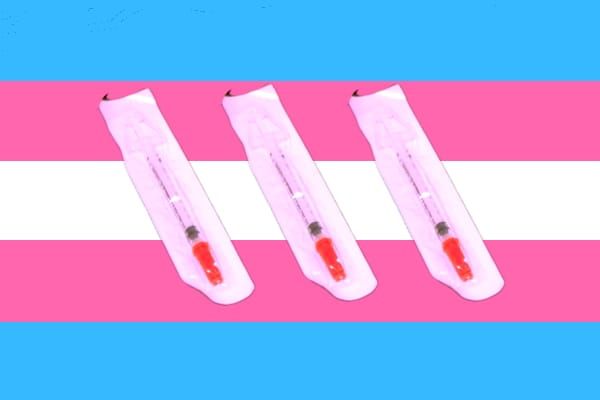
It’s Transgender Awareness Week, and tomorrow is Trans Day of Remembrance—a good time to reflect on ways to make the lives of trangender people better and easier. Transgender people are at greater risk for HIV than the general population, and trans people who use drugs face multiple levels of risk and stigma. One seemingly simple way to help trans people who inject drugs reduce their HIV risk would be to offer them safer drug use kits—including safer smoking supplies, clean syringes, and HIV prevention medications alongside gender affirming care. Access to enough new, clean syringes dramatically reduces the risk of HIV and hepatitis infection from shared needles, as well as skin wounds and infections from rough needles. (Note: the syringes people use to inject hormones for gender affirming care are typically not appropriate for injecting drugs.)
A 2021 global meta-analysis found that trans women and transfeminine people had 66 times the HIV risk compared with the general population, while trans men and transmasculine people had about seven times the risk. The reasons for this are complex and not sufficiently researched or documented. The Trump administration has forced international organizations to remove metrics that would track HIV prevalence among transgender people. Even before that, federal agencies like CDC and SAMHSA have never consistently collected data about trans people in their HIV and drug surveillance. We do, however, know that trans people are more likely to do sex work, more likely to experience homelessness, and more likely to be incarcerated—all things that can result from marginalization and stigma, and that increase HIV risk.
“We need to understand that they are a diverse range of people, with intersecting experiences,” said Pedro Ivo Oliveira, a São Paulo- based health officer at Global Action for Trans Equality (GATE). “They are also sex workers, they are also people who use drugs, they also sometimes have sexual experiences in closed, incarcerated environments,” Oliveira continued.
“These intersecting experiences are manifested into one single body, so to actually meet the necessity of this one single body, we need to address all the different ranges of extremes that this person has.”
People living in precarious circumstances have limited time to go to multiple appointments and locations for healthcare and harm reduction, Oliveira said. “So what we advocate for at GATE is more integrated services, that do not only address, for example, gender affirming care, only offer the hormones for a transgender woman. But if she also injects drugs, she must have the right to get the needle at the same door, at the same moment, and it goes as well with HIV prevention, with the vaccines that she might need, and also with the mental health care support that she needs.”
Theoretically, this should be easy, Oliveira said, “It's not a very difficult implementation strategy. It's just a political decision to actually make staff educated about it and to have what people need available to them.” Staff training is essential to ensuring that trans people who use drugs won’t feel judged or disrespected just for trying to take care of their health. Medical trauma can discourage people from seeking care, and can add to someone’s existing mental health burden. “If a person is trans, it becomes even more of a struggle for her to actually access a service, because she doesn't even know if they're going to respect her with the right name and right pronoun. So such things need to be addressed.”
Ailish Brennan, a policy analyst for Harm Reduction International, pointed out that it’s also important to address inter-community discrimination as well. “There’s definitely a stigma going both ways, and probably a lot of people who use drugs have pretty terrible opinions about trans people. And I can tell you from experience that a lot of trans people have some horrible opinions about people who use drugs,” Brennan, who uses drugs and is herself trans, said. On a cultural level, Brennan said people who are members of both communities can help bridge that divide, and on a more formal level, funding should go towards educating service providers.
“Funding is a big barrier,” to integrated services, according to Brennan. The way funding is distributed makes collaboration more complicated than it should be. When it comes to HIV prevention funding, specifically, “There is also an element when organizations are working on this short term funding basis, that they're kind of competing against each other, as fucked as it is. Key population groups [like trans people and people who use drugs] are competing against each other for this bigger chunk of HIV funding.” While advocacy organizations for trans communities and people who use drugs often work together, Brennan said that “on a service provision level, it's a bit less common.”
Found this useful? Share it: