
We keep trying the same failed strategy to make the drug supply safer
Lawmakers are still trying to use drug scheduling—which enhances criminal penalties for the possession and sale of specific illicit substances—to try to protect people from overdose and other drug related dangers, even though this strategy has repeatedly failed.
“People think if we schedule a drug, that will make everything better. And that’s not the case,” said David Zhu, a drug supply researcher and MD/PhD candidate at Virginia Commonwealth University. Zhu has been turning around papers at a rapid clip that show how, in recent years, the scheduling of one substance precipitates the proliferation of newer ones. Two papers of his published this month look at substances that emerged recently in the street drug supply: medetomidine, an extremely powerful tranquilizer, and orphines, a novel class of synthetic opioids.
Zhu’s work adds concrete evidence to a pattern that researchers have been observing for years. Each time federal lawmakers and the Drug Enforcement Administration have attempted to alleviate the toll of the opioid supply by criminalizing it further, new types of synthetic opioids, as well as adulterants that carry their own health risks, have quickly emerged as threats.
In 2018 the DEA temporarily placed all fentanyl analogues in Schedule I—the most heavily criminalized drug class. According to Zhu, “This created a regulatory vacuum for the emergence of nitazenes,” a novel class of synthetic opioids first detected in the US in 2019. Around the same time, people who use opioids began to suffer from necrotic skin wounds that caused their skin to rot. It turned out this was because xylazine, a veterinary tranquilizer, had become a common adulterant in the street fentanyl supply. When crackdowns limit the supply of fentanyl, adulterants like xylazine can enhance the effects of less concentrated batches, while novel opioids like nitazenes can serve as direct fentanyl substitutes.
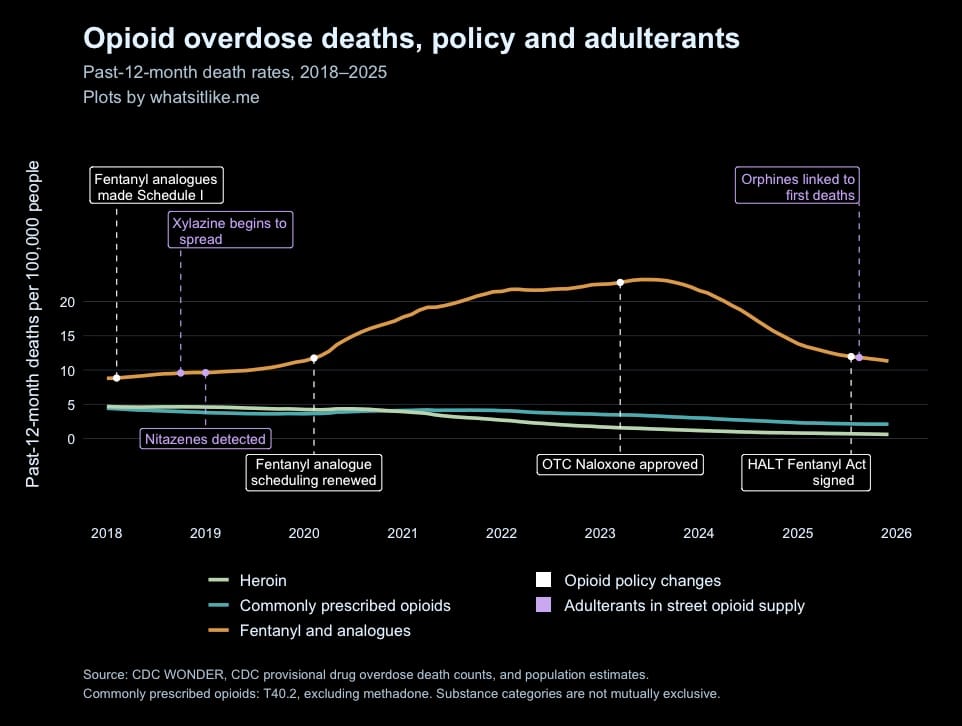
In the summer of 2025, domestic and international policies would incentivize illicit manufacturers to find more new opioids to synthesize. “The Chinese government also scheduled all nitazene compounds, and lo and behold, this led to the emergence of a new class of synthetic opioids, orphines,” Zhu explained, something he also mentions in his research letter on orphines in JAMA Psychiatry. China is often the first step in the supply chain for illicit opioids that make their way to the US, Zhu added. There may have been multiple policies at play that led orphines to emerge; the HALT Fentanyl Act, which permanently made all fentanyl analogues schedule I, was signed into law in July of 2025—the same month when orphines were first linked to US overdose deaths.
Although the timing suggests these new substances emerged in response to fentanyl scheduling—state, national and international lawmakers are nonetheless trying the same strategy to curb harms from adulterants like xylazine. Dr. Nabarun Dasgupta, an epidemiologist and founder of the Street Drug Lab at the University of North Carolina, said lawmakers should have known that scheduling xylazine was a dangerous idea. When the first state legislatures were considering the policy, Dasgupta was already studying the similarities between medetomidine and xylazine, because he suspected medetomidine might one day replace xylazine—both drugs are powerful tranquilizers and alpha-2 agonists.