
Cocaine deaths are up in many states, despite Trump’s claims —analysis of new CDC data


Drugs affect all of us, but they're polarizing to discuss. What’s it Like is an independent publication that synthesizes empathetic reporting and rigorous scientific analysis to help you separate reality from propaganda and hype. Subscribe now.
Contrary to Trump’s repeated claims that his maritime military campaign has all but stopped cocaine’s flow into the US, the coca-derived stimulant is making its way into the country just fine, according to Military.com and The Wall Street Journal —in fact, it may be more available than ever, according to NPR. The increased availability of cocaine is showing up in CDC overdose fatality data, which was updated this month. I analyzed the latest national, state and county level CDC data to figure out where overdoses were still increasing in 2025 and early 2026, and how the substances involved are shifting.
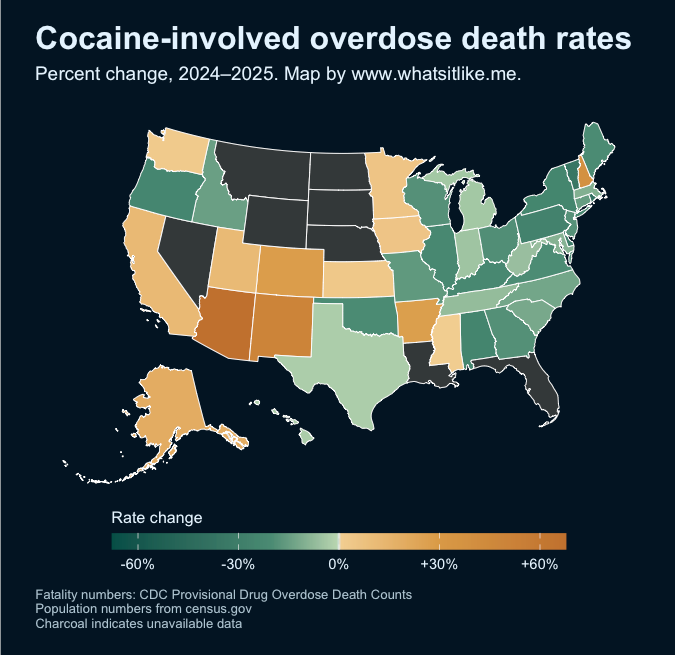
°Cocaine-involved deaths went up in 13 states in 2025. In 8 of those states, they went up by more than ten percent. While cocaine-involved deaths fell overall nationally in 2025, the decline is slowing down faster than it is for any other drug category. Because CDC does not release provisional overdose data on single-substance fatalities, we don’t know how much the decrease in cocaine deaths is driven by a decrease in fentanyl deaths.
°Overdose fatalities increased in Arizona, New Mexico and Colorado in 2025. These states form the southwest corner of the Mountain census division. All three of these states saw increases in cocaine-involved fatalities of 28% or higher—cocaine-invovled fatalities increased by 68% Arizona. Among states with data available, only one other state, New Hampshire, saw such a large increase in cocaine-involved deaths.
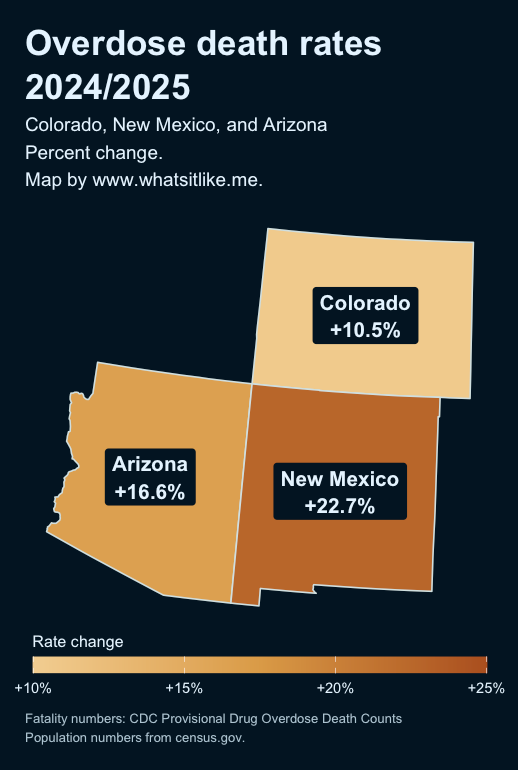
°Methamphetamine-involved deaths went up in eight states in 2025, including the three mentioned above.
°Stimulant overdoses are very different from opioid overdoses. While opioids can cause breathing to slow down or stop, overdoses from stimulants happen when the sympathetic nervous system is over activated, which can lead to overheating, racing heart rates, cardiac arrest and stroke. Recently, many overdoses involve both stimulants and opioids. Rather than cancelling each other out, using both drugs at once can hurt one organ system's ability to compensate for another—like the slowed breathing caused by opioids mean the body doesn't have enough oxygen for the stimulant-fueled racing heartbeat, which can lead to cardiac arrhythmia and failure.
°Nationally, heroin-involved deaths have fallen to their lowest rate ever since 2015, when the data set begins. This is because heroin has all but disappeared from illicit drug markets across the US.
°Fentanyl-involved deaths fell to pre-pandemic rates for the first time in late 2025.
°The national rate of decline is slowing down across fatalities involving all substances, but it has slowed down most for cocaine. Cocaine-involved death rates dropped by 26% in 2024, and 11.5% 2025, while fentanyl-involved death rates dropped by 35% in 2024 and 22% in 2025.
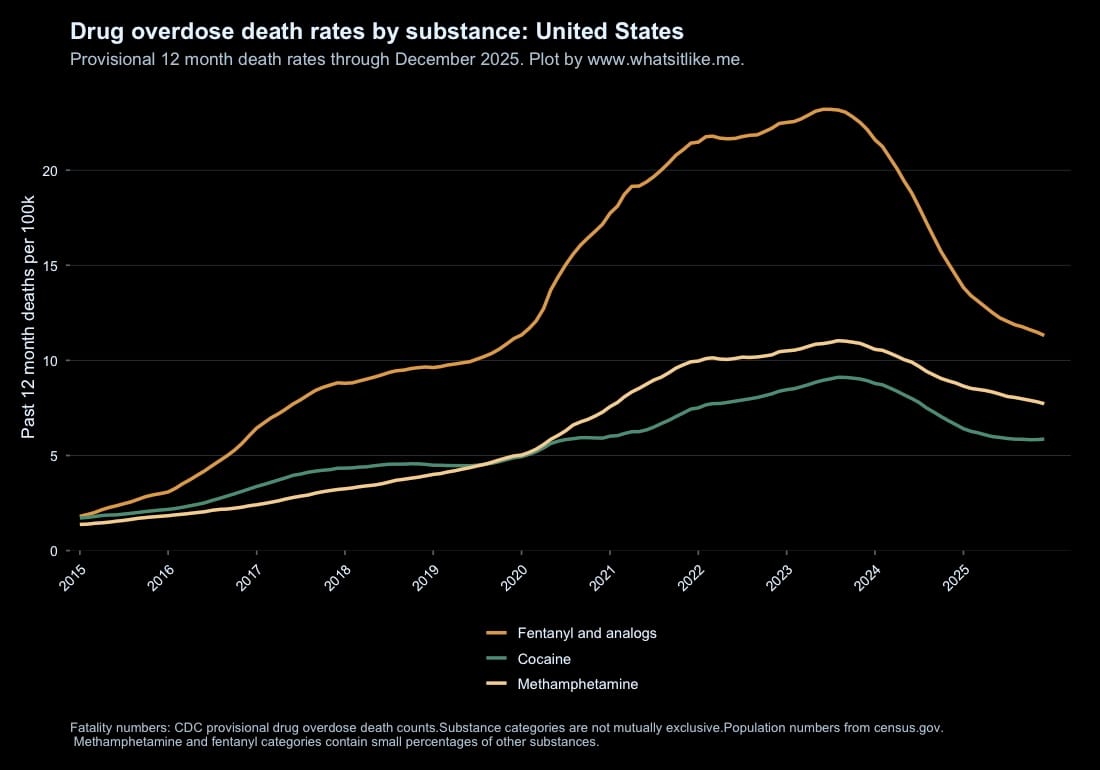
°Fentanyl and methamphetamine have consistently been involved in more deaths than other substances across states since the pandemic. While fentanyl is often framed as the primary driver of overdose fatalities, methamphetamine deaths have surpassed fentanyl deaths in multiple states since 2020. Some of these deaths likely involved other substances, including opioids other than fentanyl.
°Methadone-involved deaths have stayed consistently low, despite expanded access to methadone treatment. While methadone-involved deaths increased slightly in 2025, going from .97 per 100k to 1.05 per 100k, they have remained the most stable category, never surpassing 1.14 deaths per 100k. The highest past 12-month methadone-involved overdose death rate was 1.14 per 100k in March 2021, likely reflecting the increased overdose risk that came with isolation during the pandemic.
°Provisional data shows overdoses increased in six states and 268 counties in early 2026. States saw early 2026 increases in the West South Central, West North Central, Mountain and New England census divisions. Counties with available data in every census division saw increases.
°CDC’s provisional drug overdose dashboard does not include information on demographics. For a great, timely analysis of overdose fatalities and demographics, check out this white paper by Dr. Nabarun Dasgupta of UNC’s Street Drug Lab. The paper outlines how Black and Indigenous Americans suffer higher overdose rates, and how 70% of those who died of overdose in 2025 were Gen X or Millennial.
°Stimulant-involved overdoses are on the rise in many parts of the country. For information on stimulant harm reduction, check out resources from the National Harm Reduction Coalition and Next Distro.
Paid subscribers have access to more detailed analysis, plots and visualizations. Subscribers to the newly launched data tier can request access to my GitHub repo, which includes the code I used to conduct this analysis as well as spreadsheets that include per capita rate calculations, and spreadsheets that allow you to easily compare substance trends across states.