The THC drink industry is about to die—are we losing a healthier alcohol alternative?
The billion dollar plus THC beverage industry will be extinct in a month—unless the members of Congress who will lose their jobs in January suddenly decide they urgently need to reverse the federal hemp ban, a last-minute provision that was tacked on to legislation that ended the government shutdown last November.
Given that Congress has had a year to stop hemp ban and they haven't, it seems unlikely they’ll get it done in a month. While recreational dispensaries will still be able to tell THC drinks, the scale of the industry will shrink dramatically. When our newly blue House and Senate take control in January, it is still possible they'll reverse the ban, however. So I decided to dig into one of the THC drink industry’s main claims—that they offer a healthier alternative to alcohol.
I thought this would be a simple question to answer. Friends, I was so, so, so, so-so-so wrong about that. The answer changes a lot depending on whether you’re looking at light, moderate or heavy drinking. Comparing two vastly different bodies of scientific literature was also a challenge—we just know a lot more about the health effects of alcohol than we do about THC. And there is almost no research that looks at what edibles alone do to your long-term health, so it’s hard to know how much of the health risk associated with THC is due to inhaling smoke, which isn’t a factor if we’re talking about beverages.
I tried to break it down as simply as possible below. Paid subscribers can scroll further to see what evidence I used to come to my conclusions (anyone can access this content with a free trial!)
What if I’m looking to get lit?
If your main goal is to get as intoxicated as possible, THC drinks are safer—that is, if you can commit to actually staying away from alcohol. Getting really drunk is associated with a lot of immediate health risks, as well as long-term risks if you do it regularly. Alcohol alone can lead to fatal poisoning—weed alone cannot. Binge drinking can also increase your immediate risk of stroke and atrial fibrillation.
Drunk driving is much more dangerous than stoned driving according to multiple studies, but driving drunk and high is likely even more dangerous. Ideally, you’ll never drive drunk or stoned, but the reality is that people do both, and drunk driving carries the much higher accident risk.
People who get really, really high on cannabis do face a couple of risks that drunk people don’t, and they’re avoidable. The first risk is that you’ll get much higher than you intended because, while they’re advertised as having a faster onset than gummies, THC drinks still don't hit immediately the way alcohol does. So if you just open one can after another without waiting, as some people do with beer, you could end up feeling way too stoned, which can mean extreme anxiety and paranoia. Which leads us to one of the more worrying cannabis-associated risks—psychosis. More people have been showing up to the emergency department high and suffering from temporary episodes of psychosis since cannabis legalization. Some researchers argue that cannabis can also increase your risk of schizophrenia and other mental conditions, but this is such a complex topic I’m not going to address it in this piece. I’ll just say that it’s not clear cut.
What if I just have a glass of wine or a beer each day? Are THC drinks a healthier option?
The answer to this question isn’t really knowable based on the data that we have. There is a much stronger body of evidence on how alcohol affects our health than there is for cannabis. Still, I’d argue that one alcoholic drink a day is probably the safer option—let me explain.
In 2023, the World Health Organization announced that “no level of alcohol consumption is safe for our health,” and in 2025 the Surgeon General issued an advisory noting that alcohol is associated with at least seven types of cancer. These official warnings have been accompanied by headline after headline suggesting that even a glass of wine a day is probably bringing you closer to death’s door.
But is it???
I hadn’t looked closely at the research on alcohol until I started working on this article. Instead, I assumed that all the scientists and public health officials telling me that even a little alcohol is damaging had good data to support that conclusion. When I actually started reading the studies closely, I realized I should have known better. You can’t believe the news headline, and you can’t even believe the study’s own headline and summary—you always have to read the whole thing.
There have been several large scale studies that examine the relationship between precise levels of alcohol consumption and cancer mortality, cardiovascular mortality and all-cause mortality. And not a single one showed that people who have one drink per day or less are overall more likely to die. Yes, even light drinking is associated with an increased risk of many cancers, but it is also associated with a decreased risk of heart conditions, which are the leading cause of death globally. Researchers dispute the idea that light drinking is protective for the heart, arguing that light drinkers live healthier lifestyles, which is why they have healthier hearts. But even studies that adjust for factors like BMI, exercise and other diseases show that a drink a day or less is neutral to slightly helpful. Maybe future research will conclusively illustrate that light drinking is harmful, but so far, the evidence just isn’t certain.
So if you’re someone who has one drink or less a day, it probably doesn’t make sense to switch to THC drinks for health reasons alone. If you have two or more, however, things start to get dicier. So part of the answer to this depends on whether your one drink a day is really just one drink.
What about moderate drinking?
This one is too ambiguous for me to have an opinion either way, but there is research that suggests that any level of daily cannabis consumption could come with long-term risks, though even the most well-designed studies I could find had problems. In terms of quality of life, though, I’d say the main risk of using weed every day is dependence. Cannabis withdrawal varies widely from person to person and is pretty minor when you compare it to alcohol or opioid withdrawal, but it still isn’t fun—it can cause insomnia and severe anxiety.
Another complicating factor is that most THC drinks are so strong they’re not really comparable to a single beer or glass of wine. A 1-3 mg beverage would be more similar, could potentially help people relax without getting truly high, and might also have minimal health and dependence risks. But there aren’t really studies on what happens when you have 1-3 mg of THC a day.
Lower dose beverages have become more available recently—just in time for the THC drink industry to collapse.
People who already smoke weed might benefit more from THC drinks than light drinkers looking to switch things up
People who use THC drinks to cut down on alcohol could wind up dependent on weed when they weren't before, especially if they go for higher dose drinks. But for someone who already smokes weed every day, switching to THC beverages, even some of the time, could help prevent bronchitis and other inhalation related health problems.
When it comes to heavier use, weed starts to look like the better option, whether it's in beverage form or not
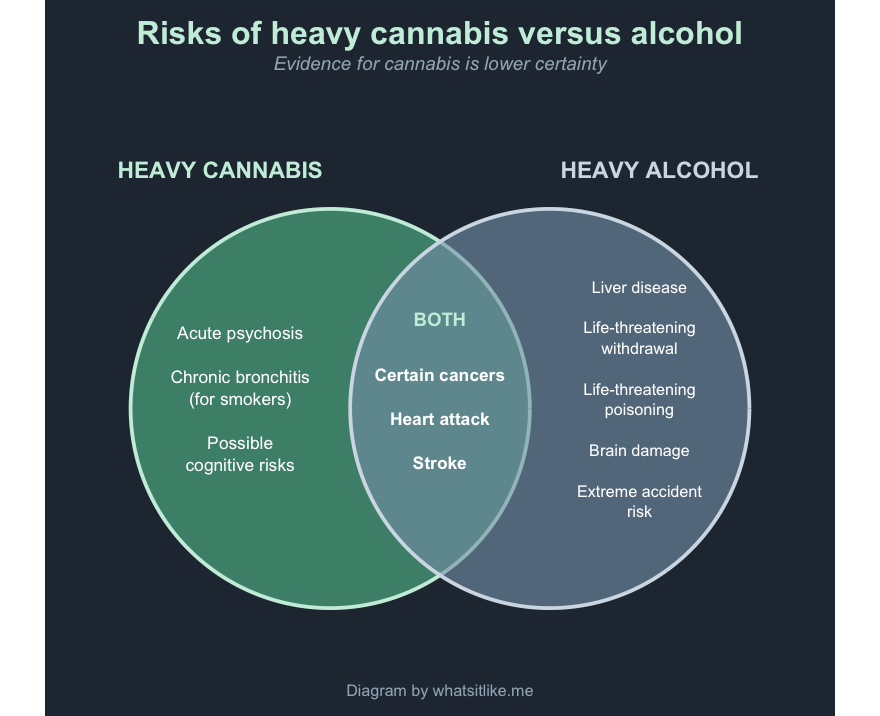
I noted above that short term heavy drinking is riskier than short term heavy weed use. This is true in the long run as well.
Cannabis is associated with health risks. The research is not as strong or well-designed as research on alcohol, partly because of cannabis's continued federal status as a controlled substance. It's hard to know how much of the risk associated with cannabis comes from inhaling smoke—I couldn't find a single long-term study on the health effects of edible cannabis alone, though I did find one study that showed smoking cannabis increased heart health risk, but ingesting it did not.
Some of the negative health outcomes associated with using cannabis might actually be the result of other things—in epidemiology, this is called confounding. Even in our state-legalization era, people who use weed daily are more likely to be low-income, which means healthcare is lower quality and harder to access. People also frequently use cannabis to self-medicate for both psychological and physical conditions, so they might be sicker overall in the first place, which can make it look like cannabis is playing a bigger role in their long-term health than it actually is. Studies that seriously investigate the relationship between cannabis and mortality show mixed results, and some of these appear to be deliberately misleading.
Alcohol, on the other hand, is unequivocally the cause of severe health risks that simply are not a concern even for the most committed stoners.
These include:
Life-threatening alcohol poisoning (no amount of THC has ever been proven fatal)
Life-threatening withdrawal (Cannabis withdrawal is real, but it isn’t deadly.)
Liver failure
While both heavy cannabis and alcohol consumption are linked to increased risk in cardiovascular disease, certain cancers and changes in brain structure, the evidence that heavy drinking causes this kind of damage is stronger and less ambiguous.
So the question then becomes, are heavy drinkers successfully switching to THC drinks?
This is another under-studied question. While some folks judge people who use weed to recover from alcohol use disorder and say they are "replacing one addiction for another," I'd say this is a good example of harm reduction, because one of those addictions comes with a lot fewer risks.
At the population level, we can see that Americans are drinking alcohol less and using weed more. How related these two data points are is hard to say.
Studies on whether going "California Sober," is helpful for alcohol recovery have mixed results. Some suggest it helps, some suggest it doesn't. But again, these studies don’t look specifically at THC beverages. For someone who is intentionally trying to cut down on drinking, having a THC drink available somewhere like a bar might be helpful. Keeping the ritual of sipping from a glass or can might also mean you miss alcohol less. The one study I could find on whether THC beverages specifically help reduce alcohol consumption showed that drinking weed helped people cut down on alcohol more than smoking it did, and that people who consumed THC drinks were also binging on alcohol less.
But for people with the most severe alcohol use disorder, a THC drink on its own probably isn't going to fix withdrawal symptoms. There are better medications for that.